

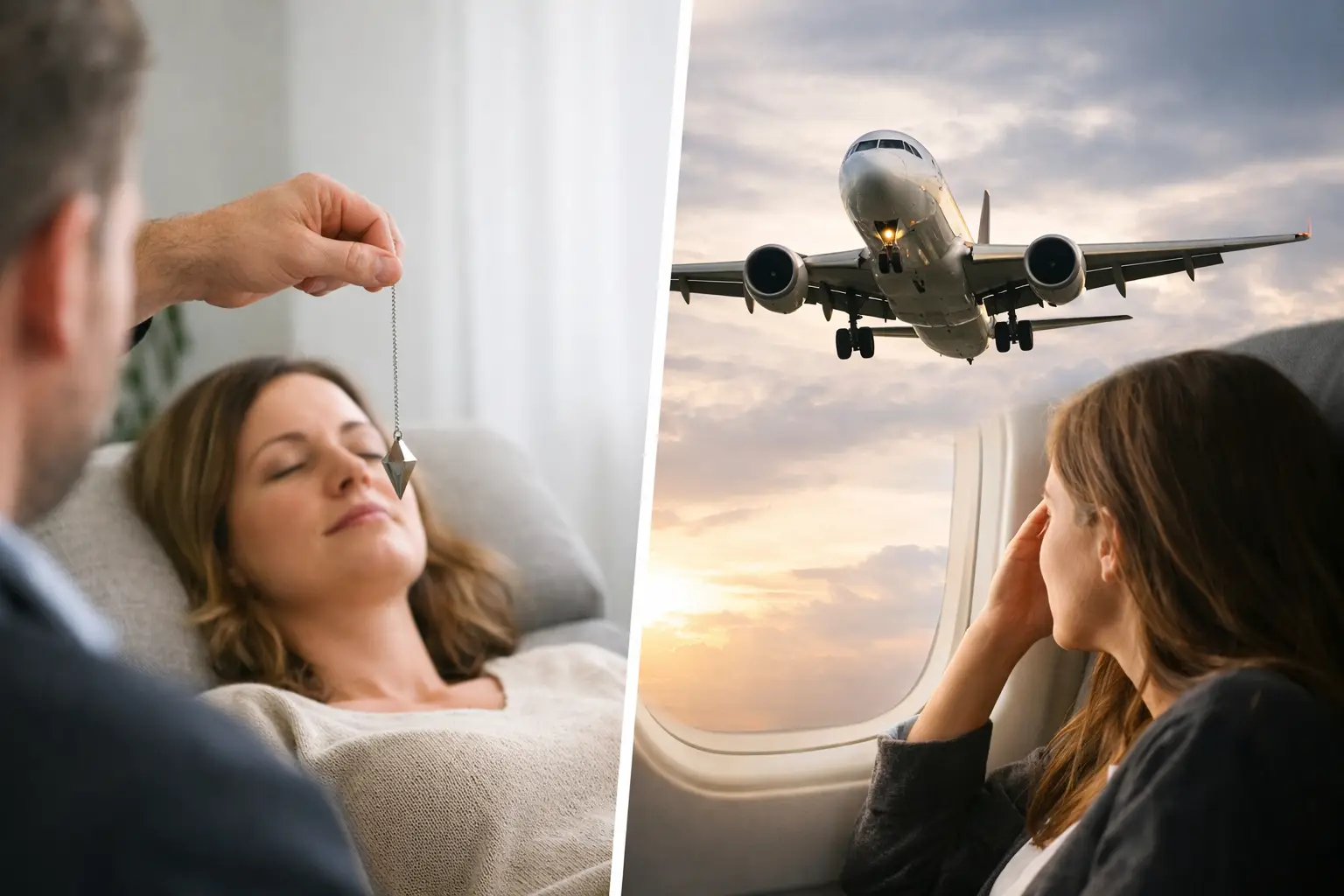
The holiday might be booked, the suitcase might be half-packed, and yet the thought of getting on the plane is making your chest tighten. For some people, hypnotherapy for fear of flying can offer a calmer, more manageable way to approach travel – not by pretending flying is enjoyable, but by helping the mind and body stop treating it as an immediate threat.
A fear of flying can be lonely and frustrating. You may look perfectly fine while quietly calculating how many days are left until departure, checking the weather forecast repeatedly, or wondering whether you can cancel without disappointing everyone. If this sounds familiar, you are not being dramatic. Your nervous system is trying to protect you, even when the level of alarm no longer matches the situation.
Fear of flying is rarely just about the plane
Some people are frightened by turbulence. Others worry about losing control, feeling trapped, having a panic attack in front of strangers, or being unable to leave once the cabin door closes. For others, the fear begins long before the airport: booking the flight, seeing news coverage of an incident, or imagining their children travelling without them can all set anxiety racing.
This matters because there is no single script for overcoming a flying fear. Two people might both avoid holidays abroad, yet need very different support. One may understand that flying is statistically safe but still feel overwhelmed physically. Another may have had a frightening flight, a difficult life event, or a panic attack that their brain now links with being on an aircraft.
The aim is not to talk you out of your feelings. It is to understand what sets off the fear, what keeps it going, and what would help you feel more in control.
How hypnotherapy for fear of flying can help
Hypnotherapy is often misunderstood. It is not about someone taking over your mind, making you cluck like a chicken, or forcing you to board a flight against your will. You remain aware, able to speak, and in control throughout. Most clients describe it as a focused, deeply relaxed state – rather like being absorbed in a book or drifting just before sleep.
When anxiety is high, the rational part of the brain can struggle to get a word in. You may know the facts about aviation safety, but your body is still behaving as though there is danger right now. Hypnotherapy can help reduce that automatic alarm response, while psychotherapy-style conversation helps make sense of the thoughts, memories and patterns behind it.
Sessions may include guided relaxation, imagery, grounding techniques and practical ways to respond to anxious thoughts. Rather than simply repeating positive statements, the work is tailored to you. If turbulence is the main trigger, you might work on how your body interprets unfamiliar movement. If the fear is being trapped, the focus may be on coping with sensations of panic and building confidence that you can ride out discomfort without needing to escape.
The goal is not necessarily to feel completely relaxed from take-off to landing. That can be an unhelpful pressure in itself. A more useful aim is to feel able to fly even if nerves show up – with a clearer head, steadier breathing and practical tools you trust.
What keeps the anxiety going
Avoidance brings quick relief, which is exactly why it is so powerful. Cancelling a trip, choosing a very long drive, or relying heavily on alcohol or sedatives may make the fear feel quieter in the short term. But the brain can learn that avoidance was what kept you safe, making the next flight feel even harder.
Reassurance can work in a similar way. Looking up turbulence predictions ten times a day or repeatedly asking a partner whether the plane will be safe can briefly settle the worry. Then the doubt returns, often louder than before.
Therapy does not ask you to throw away every comfort straight away. It helps you notice the habits that are unintentionally feeding the fear and replace them gradually. That might mean practising a calming technique before looking at flight information, reducing compulsive checking, or learning to sit with a rush of anxiety without immediately trying to get rid of it.
What happens in a session?
A good first session is a conversation, not a performance. You can talk openly about what happens before, during and after a flight, as well as what you have already tried. There is no judgement if you have avoided flying for years, taken medication, needed a drink at the airport, or only travelled because you felt you had no choice.
Together, you would explore your particular triggers and agree what you would like to change. That may be taking a family holiday, attending a wedding abroad, managing a work trip, or simply not feeling sick with dread whenever someone mentions a plane.
Hypnotherapy may be part of the session, alongside practical therapeutic work. You may be given simple exercises to use between appointments, such as breathing practice, visualisation or a recording to support relaxation. The right approach depends on your history, how intense the fear is, and how soon you are due to travel.
Some people notice a shift quite quickly. For others, especially where panic, trauma or wider anxiety are involved, it takes longer. Honest therapy makes room for both. There are no guarantees, but there can be meaningful progress when the work is personalised and practised.
Preparing for a flight without feeding the fear
If you have a flight coming up, preparation can make a real difference. The trick is to prepare in a way that supports you, rather than turning every detail into another anxiety ritual.
Start by making the journey as predictable as possible. Allow enough time to get to the airport without rushing, choose comfortable clothing, and think about what helps you feel settled during waiting time. A familiar playlist, an audiobook, a puzzle or a calming recording can give your attention somewhere useful to go.
It can also help to decide in advance how you will respond if anxiety rises. For example, you might put both feet on the floor, slow your exhale, name a few things you can see around you, and remind yourself: this is anxiety, not danger. Panic feels urgent, but it always passes.
Try not to make feeling anxious the test of whether you can cope. You can be nervous and still do the thing. Every moment you stay with the experience, rather than escaping it, gives your brain new evidence that you are more capable than fear has been telling you.
When extra support is needed
Fear of flying sometimes sits alongside broader anxiety, claustrophobia, health anxiety, trauma or panic attacks. If you are struggling with daily life as well as travel, it can be helpful to address the bigger picture rather than treating the flight as an isolated problem.
If you are considering medication for flying, speak with your GP or prescribing clinician. For some people, medication may have a place; for others, it may not suit them or may make them feel less in control. Therapy can work alongside appropriate medical advice, but it should not replace it.
It is also worth being wary of any service that promises a one-session cure. A short piece of focused support may be enough for some people, particularly if a flight is approaching. But lasting change often involves understanding the pattern, practising new responses and being kind to yourself when progress is not perfectly linear.
A calmer relationship with travel is possible
At Emma Newman Hypnotherapy, support is built around real conversations and practical change, not a one-size-fits-all script. Sessions can take place in Middleton or by video across the UK, which may feel like a gentler starting point if even discussing flying brings up a lot of anxiety.
You do not need to prove that your fear is bad enough before asking for help. Whether you have avoided planes for decades or are dreading one flight next month, the first step can simply be talking it through. Fear may be loud, but it does not have to make every decision for you.



0 Comments